Copper Patina Timeline Calculator
If you’ve ever asked, “How long will it take for this copper to turn green?”—you’re not alone. The answer? Well, that depends on several variables.
What if we made a copper calculator showing these variables and estimating how long copper patinas take to mature?
Note: This calculator is for testing purposes only. As anybody who has worked in the world of oxidizing patinas will tell you: patination as much an art as a science. Any definitive claim of how long a patina will take to naturally mature to its finished state is at best an approximation.
Copper patina timeline calculator
First green in about 4.1 years, full patina 15 years
Bright mill finish, straight off the roll.
- New
- 2 mo
- 4 mo
- 6 mo
- 4.1 yr
- 10 yr
- 15 yr
An estimate, not a promise: patina is as much art as science. Photos: one copper panel aged with Google Gemini from photographs on Wikimedia Commons (new copper, CC BY 2.0; weathering, CC BY 2.0; verdigris, CC BY-SA 3.0).


With all that said, understanding the general aging process of raw copper can help designers, architects, and builders set expectations for the client. That is what we hope this calculator elucidates!
Using the copper patina calculator
Pick a climate (general ones like Coastal or Arid, or a city like San Francisco, London or Lima), then say where the copper is: a roof, a steep roof or dome, a wall, or somewhere sheltered. Adjust the sliders to match your site. Rain and humidity move together, because a rainy climate can't have desert air (the reverse does happen, though: Lima gets almost no rain and lives in fog).
You get the years to the first green and to full patina, the copper's color at any age, and the whole timeline as photos.
Copper’s transformation isn’t a straight path, and predicting it is far from an exact science. Climate, humidity, pollution levels, salt exposure and the angle of installation all play a role. Copper moves through distinct oxidation phases before settling into the familiar blue-green patina. But that final stage can take decades—or never happen at all in certain conditions.
How Copper’s Patina Forms
Raw copper starts as a bright, almost rose-gold metal. Within weeks it darkens, and within a year it’s an even brown, almost anywhere: that’s cuprite, a copper oxide, and it only needs air and a little moisture. The green comes much later and much more slowly. It’s mostly basic copper sulfate (brochantite), built from sulfur in the air, plus copper chlorides near the sea, and it only grows while the surface is wet. So the things that matter are how long the copper stays wet, how warm it is, and how much sulfur and salt the air brings.
In a dry climate, copper might stay brown for decades. In a coastal setting, it could develop a green patina in under ten years. Industrial environments with high sulfur levels accelerate the process, while sheltered areas can delay it indefinitely. And, the same sheet of copper on a roof may patinate differently than one on a vertical wall.
Why no one can give you an exact date
- Climate: temperature, humidity, rain, sulfur and salt air set the pace. Those are the calculator’s five sliders.
- The air has changed: coal smoke turned copper green fast. Sulfur in American and European cities has dropped by over 90% since the 1970s, so a new roof in New York greens far slower than the Statue of Liberty did (try New York, 1900).
- Orientation: roofs turn faster than walls, because water sits on them longer.
- Shelter: soffits and covered walls can stay brown indefinitely.
- Runoff: water off nearby stone, mortar or other metals changes the color.
The de Young: copper in the fog
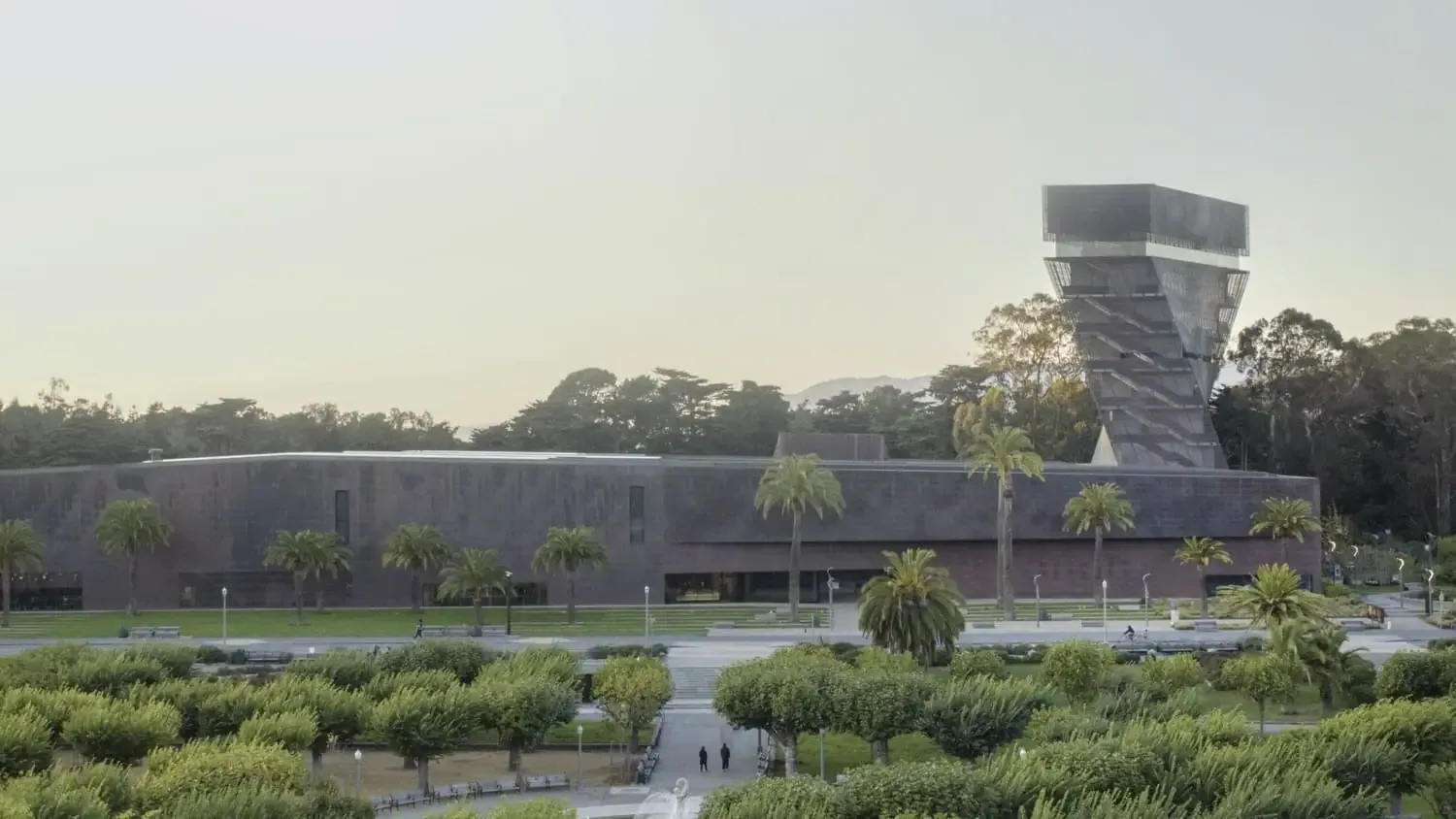
The de Young museum in Golden Gate Park (Herzog & de Meuron, 2005) is wrapped in perforated, dimpled copper panels fabricated by Zahner. It was always meant to weather, and Zahner expected brown, then black, then green over twenty or thirty years. San Francisco is damp enough, but its air is cool and clean, there’s no rain for half the year, and the panels are walls, where water runs straight off. Ten years in, the green showed only along the seams; twenty years on it’s still mostly brown. Choose San Francisco and Wall in the calculator: first green at about 14 years, full patina near 60.
The four stages of copper patina
Bright rose-orange, darkening within weeks.
An even chocolate brown, near black in city air.
Green streaks start where water runs and sits.
The settled blue-green, which protects the metal under it.
Those are typical ranges, and roofs sit at the fast end. A warm, salty coast can get a roof there in about ten years; a wall in clean air takes decades; a desert may never.
Skip the wait: preweathered copper
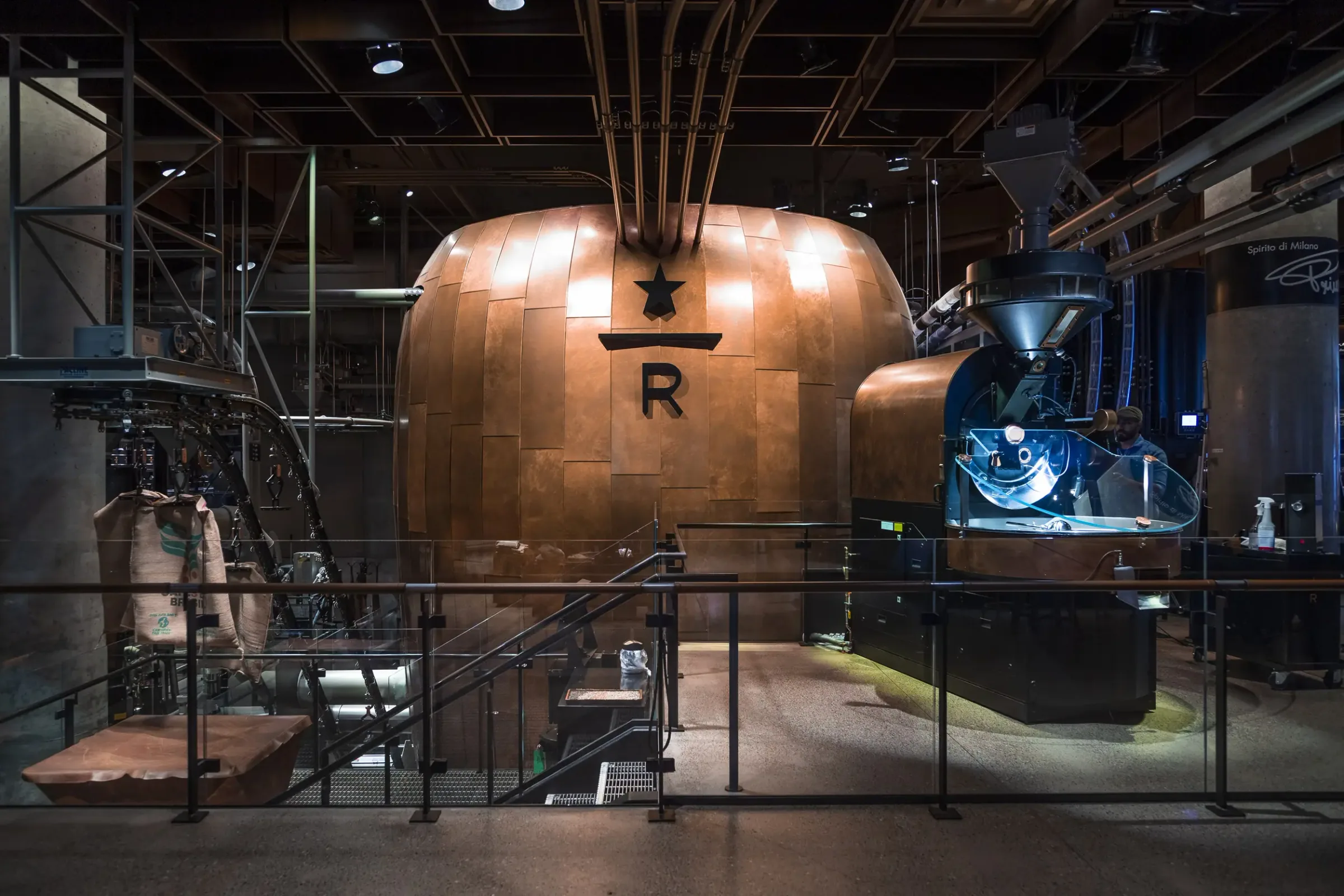
Fabricators can patinate copper in the shop so it arrives looking finished. You get the final color on day one, an even finish without the streaky middle years, and less runoff staining on the stone below. It keeps aging after install, more slowly and more evenly.
Photographing copper
Copper won’t look the same in five years as it does at handover, so the day it’s finished is the day to photograph it. We shoot completed buildings for fabricators like Zahner. See our architectural photography, and our work for Dissimilar Metal Design, Zahner and Poma Metals.